User experience has spent decades teaching designers to empathize with users, but remarkably little time asking what it would mean for the things they design to do the same. Having studied human beings so exhaustively, we congratulate ourselves for building systems that occasionally acknowledge their humanity.
Empathy – it’s a sacred principle in the UX profession. We advocate the importance of conducting interviews, observing behavior, constructing personas, mapping journeys, and dedicating considerable energy to understanding what people want, need, fear, and struggle with. It’s a point of professional pride, a defining characteristic of human-centered design, and one of the things its practitioners routinely invoke to distinguish the work my profession creates from things that are merely functional or look attractive.
We’ve built a sophisticated epistemology of empathy that I worry has advanced faster than our practice of building empathetic interactions. The research is often valuable, and the resulting products better for it. But our extraordinary investment1 in understanding people doesn’t seem to manifest in genuinely empathetic behavior in the experiences we create.And by investment, I mean both in effort and in rhetoric.
Empathy as virtue
Perhaps the first problem is that we’ve come to think of empathy as something a designer possesses, rather than something a design can exercise. We study people, learn2 about their needs, patternize those needs, and translate those patterns into requirements, flows, and interfaces.Sometimes / occasionally / often this can become a list of assumptions or stereotypes rather than true learning, but that’s a digression for another time… Empathy informs our judgment, but the resulting experience remains anchored in those patterned assumptions. Empathy for the user becomes embedded in the designer’s toolkit.
Consider the persona, one of the profession’s more enduring artifacts.3 It makes the needs of different people tangible, reminding decision-makers that their own perspectives aren’t universal.They’re also among the more divisive artifacts in design, provoking something approaching religious disputes over their usefulness, often accompanied by a No True Scotsman defense: where personas fail to deliver value, the problem is invariably that they weren’t real personas to begin with. But it also collapses human variation into a manageable number of archetypes to design and optimize for. Abstraction is essential to working at scale, but it’s a peculiar endpoint for a discipline so committed to understanding individuals.
The designer gets to know the user. The product generally doesn’t. The empathy exercised in making design decisions becomes, almost by inheritance, an attribute of the behaviors they produce. We call an undo button empathetic because it acknowledges that people make mistakes. We call progressive disclosure empathetic because it accommodates cognitive limitations. These can be consequential improvements, but they’re evidence of what the designer understood in advance, not of the experience developing an understanding of the person using it.
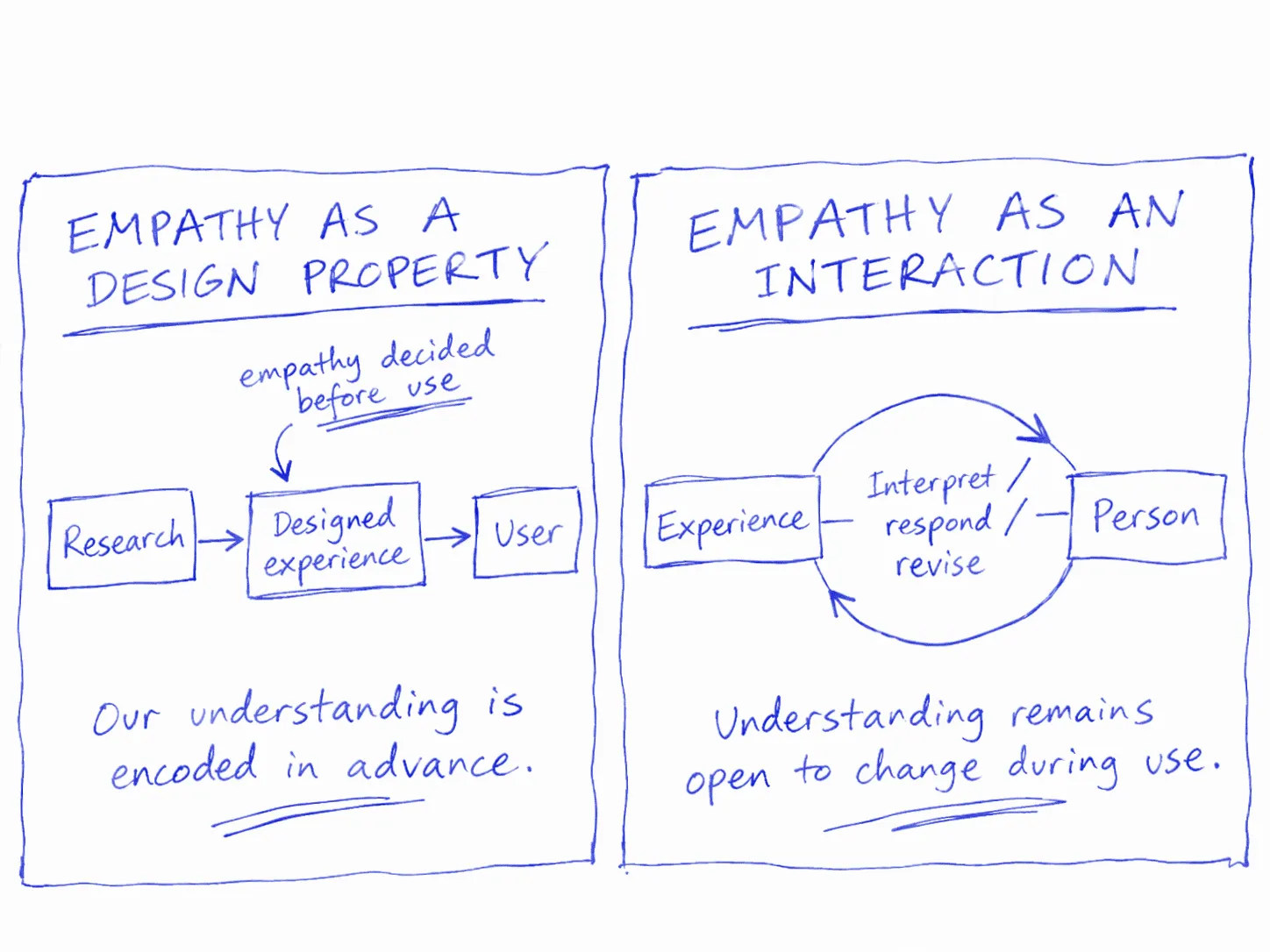
It’s like someone spending weeks learning about your life, your aspirations, and your anxieties, tailoring a script to what they’ve learned—and insisting on following it every time you speak. We probably wouldn’t consider that person particularly empathetic.
When empathy becomes a specification
Much of this work is commissioned by organizations that want people to do something: buy a product, adopt a service, complete a transaction, remain subscribed. These are legitimate commercial objectives, and good design can create value on both sides of the exchange. But knowing something about people in advance and remaining open to what a particular person is telling you are different activities.
Something happens as empathy passes through the machinery of product development. We ask what people need, learn what motivates them, and translate that understanding into flows, features, and interactions designed for particular outcomes. Research becomes a rationale for decisions; decisions become specifications; specifications become the rules governing the encounter.
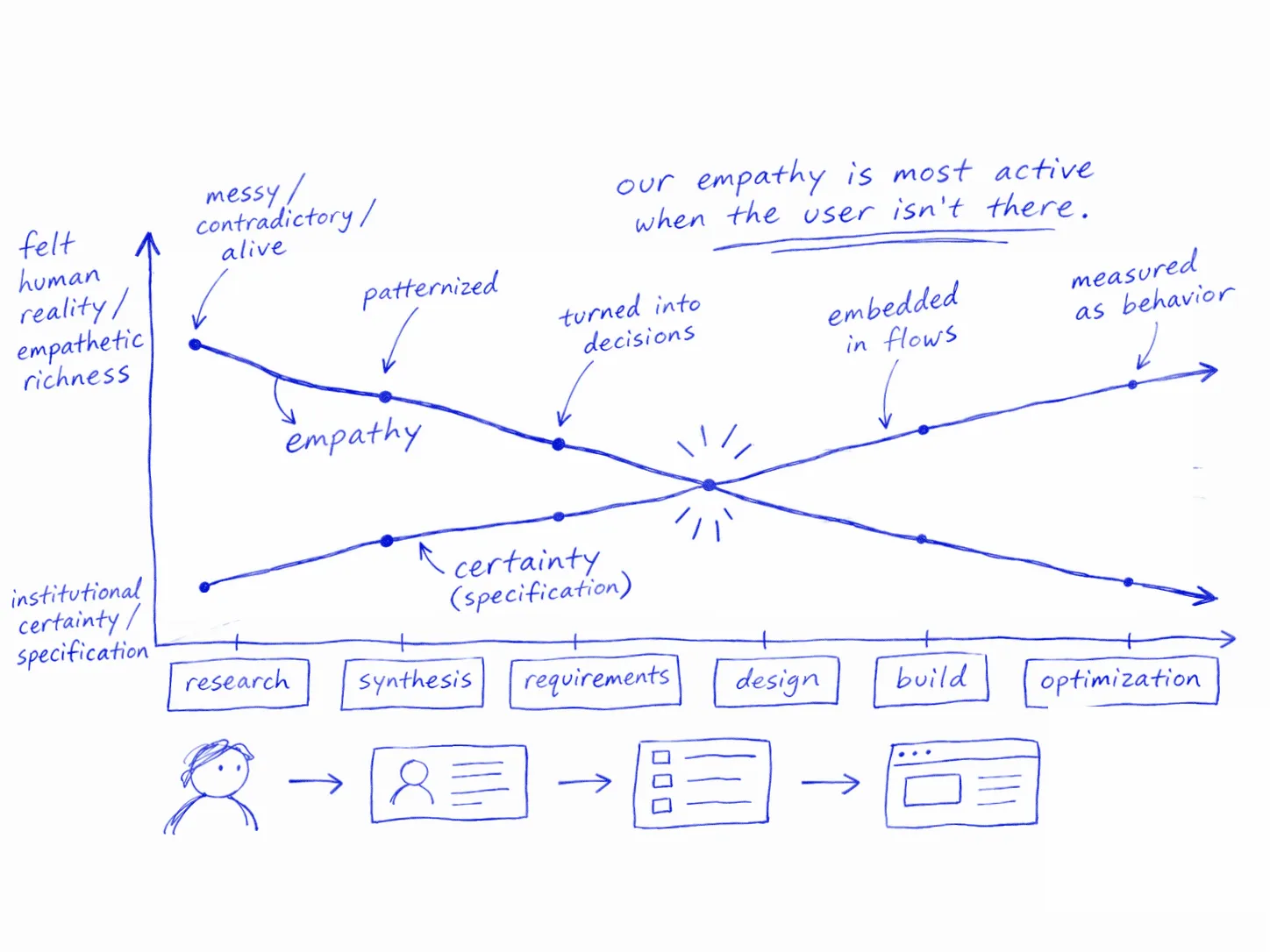
Our empathy is most active when the user isn’t there.
By the time someone arrives, our understanding has hardened into assumptions about what they want and how they should behave. The experience responds to their actions, but rarely reconsiders what those actions mean. It registers a changed selection, a repeated search, an abandoned form, without necessarily questioning whether it misunderstood the task from the start.
For much of digital design’s history, there was little room for interpretation once an experience was built. But the limitations of a medium have a way of becoming the assumptions of a profession. We’ve treated empathy as a source of design authority, when perhaps it should also be a continuing source of uncertainty.
What happens when the interface can listen?
Systems have the ability to interpret context, entertain competing explanations of intent, and modify their responses4—not always well, and certainly not without risks.What’s interesting is this capability isn’t new – it’s been the promise and bleeding edge of technology my entire career – but it’s now available to more people at cheaper cost than ever, which at the risk of trying to predict the future suggests this will move from exceptional to typical. What was once a static representation of our understanding might become an ongoing negotiation of it.
That possibility opens a massive well of moral and ethical questions. But there’s an experience-centric question I’m not sure we’ve answered: what would empathy actually look like during an interaction?
It would have to be more than knowing a lot about someone and endlessly personalizing their experience. A system that confidently predicts what I want may be helpful, but also deeply presumptuous. More sophisticated inference could reinforce our assumptions, making them harder to escape. Someone repeatedly changes the dates of a trip. A conventional interface refreshes the results; an adaptive one infers a preference for flexibility. But perhaps the person isn’t sure they can travel at all. A more empathetic exchange wouldn’t have to divine the answer. It could make room for them to explain.
There’s a difference between responding to a user’s actions and allowing an interaction to be affected by them. Perhaps empathy has less to do with how accurately a system models someone than with whether that person’s participation can change what it thinks is happening. It might ask rather than infer, offer alternatives rather than prescribe, or accept correction. None of this requires a machine to feel anything. It requires us to consider the consequences of designing something that behaves as though it understands another person.
I don’t yet know what a practice of designing for that kind of exchange looks like. It’s surely more difficult than adding a conversational layer, and I’d rather leave the question open than turn it into another checklist that supposedly proves our empathy.
For decades, we’ve approached empathy largely as a way of knowing people. But perhaps the next frontier of empathetic design isn’t learning more about our users. It’s building experiences that can recognize when what we think we know about them is wrong, and do something meaningful with that recognition. After decades of claiming to put users at the center, perhaps the most empathetic thing UX could do is become a little less certain that it knows what’s best for them.
Notes
-
And by investment, I mean both in effort and in rhetoric.
-
Sometimes / occasionally / often this can become a list of assumptions or stereotypes rather than true learning, but that’s a digression for another time…
-
They’re also among the more divisive artifacts in design, provoking something approaching religious disputes over their usefulness, often accompanied by a No True Scotsman defense: where personas fail to deliver value, the problem is invariably that they weren’t real personas to begin with.
-
What’s interesting is this capability isn’t new – it’s been the promise and bleeding edge of technology my entire career – but it’s now available to more people at cheaper cost than ever, which at the risk of trying to predict the future suggests this will move from exceptional to typical.