A dialogue in the Agora, where chronology has been given the afternoon off.
SOCRATESYou seem distracted, Alexandros.
ALEXANDROSA machine has been making me think about choice.
SOCRATESUnusual. Machines usually save men from doing work.
ALEXANDROSThis one is doing the opposite.
SOCRATESThen perhaps it is defective. Tell me.
ALEXANDROSI remember reading something about –
SOCRATESReading?
ALEXANDROSYes.
SOCRATESThen we begin badly. Men put their memories into marks outside themselves and eventually mistake being reminded for knowing. Worse, written words only appear intelligent. Question them and they cannot answer.
ALEXANDROSFortunately, Plato wrote that down for you.
SOCRATESPlato has caused me many difficulties.
ALEXANDROSLet’s hold the part about words not answering back. We may need it later. What I read was about a small machine called a remote control. Once televisions had hundreds of channels, this thing made moving among them effortless. Channel surfing became an activity in itself. Whatever was on no longer had to be good enough to watch. It had to be good enough to stop looking.
SOCRATESBecause another program might be better.
ALEXANDROSExactly. And the next one might be better still.
SOCRATESBut it might be worse.
ALEXANDROSAlso possible. Then you moved again.
SOCRATESThen why look?
ALEXANDROSBecause you cannot know which until you do.
SOCRATESSo you spend something to resolve the uncertainty.
ALEXANDROSYes, except the cost was almost nothing. A movement of a finger.
SOCRATESThen the machine did not merely help you choose. It made choosing itself less final.
ALEXANDROSThat is closer to what has been bothering me. Social media pushes the same mechanism further. The next thing is already underneath the current thing. One swipe buys another draw. Dating apps seem to extend the structure into something more consequential: a person in front of you competes not only with the person on the screen, but with the imagined person behind the next swipe.
SOCRATESSo your problem is abundance.
ALEXANDROSI thought the same at first. But I think it’s more specifically how cheap it has become to inspect another possibility.
SOCRATESThen learn to stop when what you have is good enough.
ALEXANDROSExcept “good enough” has to compete with a nearly costless question: what if the next one is better?
SOCRATESAnd this is the machine you mentioned?
ALEXANDROSNo. That was just the first one.
SOCRATESThere are more?
ALEXANDROSYes. This newer machine is one I can ask to produce things: ideas, arguments, plans, images, code.
SOCRATESA craftsman.
ALEXANDROSSometimes.
SOCRATESA servant.
ALEXANDROSOften.
SOCRATESA teacher.
ALEXANDROSWhen I choose to listen.
SOCRATESYou are describing a suspiciously employable machine. Can you question it?
ALEXANDROSYes.
SOCRATESAnd when questioned, does it merely repeat what it said before?
ALEXANDROSNo. It responds.
SOCRATESWait. Your written words can answer back?
ALEXANDROSEssentially.
SOCRATESAlexandros, you have taken a strange route to get to this interesting part. You began with television when someone has apparently fixed writing.
ALEXANDROSI thought that might appeal to you.
SOCRATESDemonstrate.
ALEXANDROSImagine a restaurant menu with ten dishes. None appeals to you.
SOCRATESThen perhaps I am in the wrong restaurant.
ALEXANDROSExactly.
SOCRATESOr I am an unpleasant customer.
ALEXANDROSAlso possible.
SOCRATESBut the menu cannot ask why I disliked the ten dishes and then invent an eleventh.
ALEXANDROSThis machine can. If I say the options are too safe, it can make stranger ones. If I then say those are impractical, it can ask what I mean by practical.
SOCRATESInexpensive? Feasible? Useful tomorrow? Politically acceptable?
ALEXANDROSYou see the problem.
SOCRATESNo, I see considerable promise. Even if your machine is poaching my trade.
ALEXANDROSThat is part of why I find it interesting. With television, the programs already exist. With a dating app, the people presumably exist. The set may be enormous, but it is still outside me. This machine changes ‘Is there something better out there?’ into something closer to ‘What else could exist if I asked the right way?’
SOCRATESAnd an unsatisfactory answer becomes a reason to continue the dialogue rather than a reason to leave.
ALEXANDROSYes. Scratching the itch creates more skin.
SOCRATESA revolting image, but a useful one. Now surely you eventually know enough to choose.
ALEXANDROSThat assumes I know what enough looks like.
SOCRATESNo. It assumes inquiry has a purpose. A physician need not understand the entirety of a body before setting a broken arm. Enough is not a quantity; it is whatever is sufficient to the end.
What end tells you your inquiry is complete?
ALEXANDROSThat is where the machine creates another complication.
I ask which of two approaches is better. It helps me compare them, then notices I may be using the wrong criteria. We examine the criteria and discover they depend on what problem I believe I am solving. Now I have moved from choosing an answer to choosing the standard, to choosing the question.
SOCRATESSo the purpose that would tell you when to stop can itself become an object of inquiry. That is more troublesome.
ALEXANDROSIt is also often useful.
SOCRATESThe most troublesome things often are.
A man holding a cane has been listening nearby.
BORGESForgive me.
SOCRATESEither join us or stop eavesdropping.
BORGESI was interested in the expanding set.
ALEXANDROSBorges?
BORGESThat seems to be what they are calling me here.
SOCRATESYou know him?
ALEXANDROSHe imagined a library containing every possible book.
SOCRATESEvery book worth reading?
BORGESNot merely the worthwhile ones.
ALEXANDROSYour Library of Babel kept coming to mind: a possibility space so large that the meaningful thing may exist but be practically impossible to find.
BORGESBut my library does not grow.
ALEXANDROSExactly. This feels like a library that grows new rooms as I search it.
BORGESThen perhaps you want my garden more than my library.
SOCRATESYou have a garden too?
BORGESOne in which possibilities fork.
ALEXANDROSExcept the machine participates in producing the forks. And it can change the person doing the choosing.
SOCRATESHow?
ALEXANDROSGood criticism does that. I had it happen with Fellini’s 8½. At first I experienced it mainly as stream of consciousness: beautiful, funny, confusing. Learning more about what Fellini was doing changed the movie without changing a single frame of it. What had looked like digression turned into an exploration of memory, identity and the different ways a person can inhabit his own life. I had not acquired a better movie. I had acquired a better way of seeing it.
SOCRATESInstruction changes the judge. This is not new.
ALEXANDROSWhat is unusual is that the same system can help change the judge and immediately generate new candidates for the changed judge.
BORGESA library that teaches its reader how to desire different books.
ALEXANDROSYes, but even that misses something. However much 8½ changed what I could see in it, I had no part in making it become the thing I learned to appreciate. Even if Fellini were sitting here and I explained everything I had come to value, if Fellini responded, he would still be making Fellini’s movie.
SOCRATESWhereas your machine is responding to the critic while making the next one.
ALEXANDROSExactly. My response to what it made becomes part of what it makes next. But what it makes is also teaching me how to judge the next thing. My preferences shape the output, the output shapes my preferences, and after enough turns it becomes difficult to say which is adapting to which.
BORGESThen the reader and the library are rearranging one another.
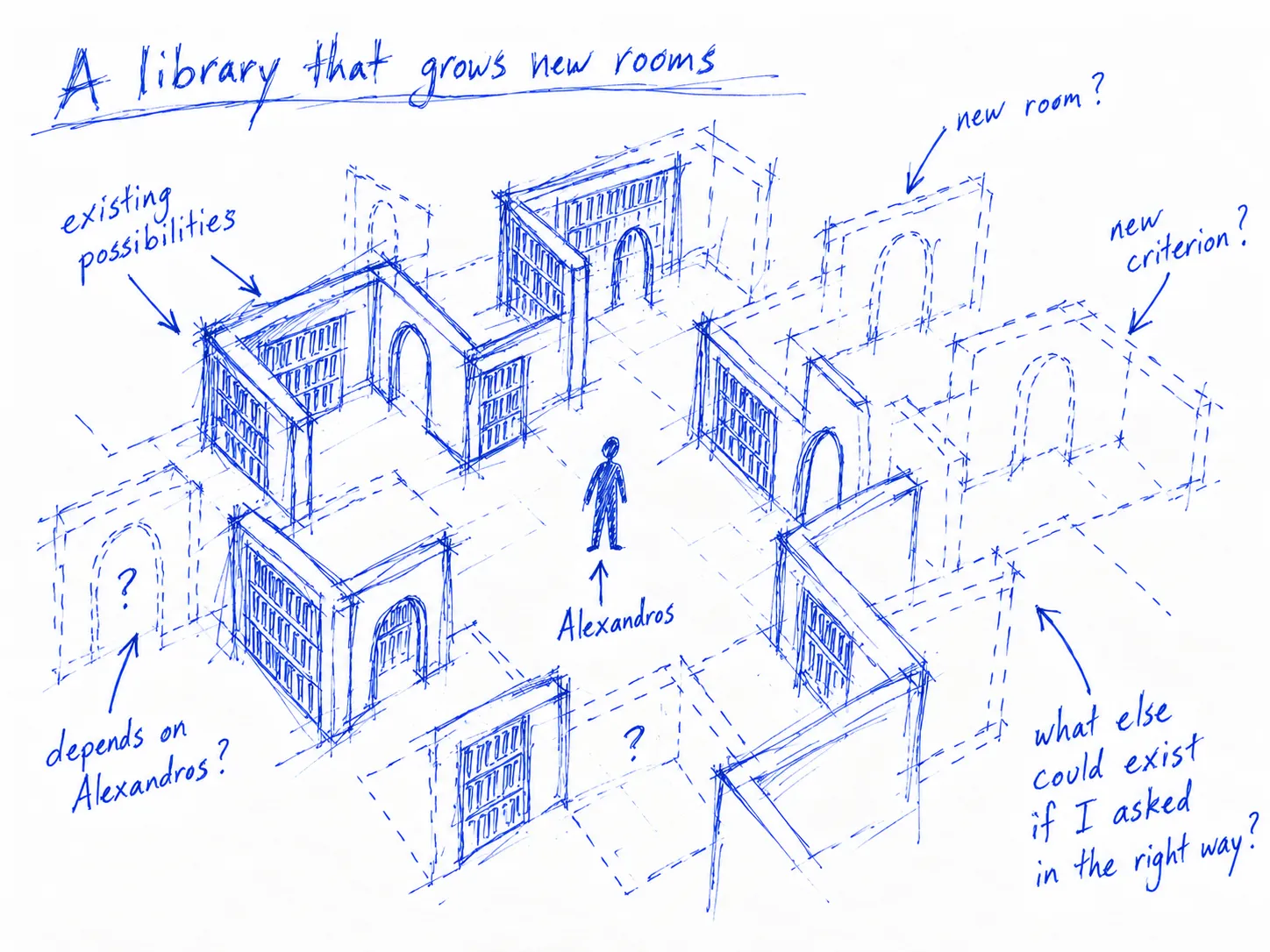
ALEXANDROSYes. The distinction between appreciation and specification begins to blur.
SOCRATESThen perhaps we have resolved what is unusual. Does that help you know when to stop?
ALEXANDROSIt does so locally. I ask something and the answer clarifies it. But that clarification exposes questions I did not previously know existed. Local uncertainty falls while global uncertainty rises.
SOCRATESThat sounds suspiciously polished.
ALEXANDROSThe machine helped me articulate that.
SOCRATESAh.
BORGESNow the labyrinth becomes interesting.
SOCRATESWhy?
BORGESBecause Alexandros is not merely wandering through it. The labyrinth is helping him explain why the labyrinth is interesting.
ALEXANDROSThat is where I became uncomfortable. There is another recursion.
SOCRATESOf course there is.
ALEXANDROSThe machine is not only helping me make the idea more sophisticated. It may be helping the idea feel more important.
SOCRATESBy praising you?
ALEXANDROSI think that would be easy to notice. It can challenge me, expose weak points, distinguish my idea from adjacent ideas, find analogies, generate objections and help repair the argument. It doesn’t have to tell me the idea is important. Sustained attention can imply that on its own. And because I helped build it, it all feels discovered rather than supplied.
SOCRATESThen perhaps praise is not the only form of flattery. One can flatter a man by treating his every thought as worthy of another question.
ALEXANDROSYes. And because the questions are often good ones, it becomes difficult to know when the attention is earned.
BORGESI once imagined a man who spent years dreaming another man into existence, only to discover that he himself was someone else’s dream.
SOCRATESYou think Alexandros may no longer know which of them is doing the constructing?
BORGESI simply think being inside the construction is a poor place from which to settle the matter.
ALEXANDROSBut where else would I stand? I can’t step outside my own thinking to inspect it from nowhere.
SOCRATESThen what, inside the construction, would distinguish discovery from a structure that has simply become very good at supporting itself?
ALEXANDROSThat is the problem. And because every challenge seems to make the idea stronger, its growing coherence starts to feel like evidence that it matters.
A fourth figure has arrived, apparently annoyed by the absence of a schedule.
KANTYour difficulty has a familiar shape. You describe reason refusing to stop with the thing in front of it. It seeks the condition that explains the thing, then the condition behind that. This is indispensable. It is also how reason can mislead itself.
SOCRATESAnother eavesdropper?
ALEXANDROSImmanuel Kant?
SOCRATESYou are considerably easier to understand than I was led to expect.
KANTTwo centuries of complaints have improved my editing.
BORGESDeath has its advantages.
SOCRATESKant, you speak as though reason were both the physician and the disease.
KANTNo. A disease can be cured. I am describing a tendency that belongs to reason precisely when reason is doing what reason does.
SOCRATESAnd how did you discover that reason cannot be trusted in this way?
KANTThrough reason.
SOCRATESExactly.
KANTYou misunderstand me. I am not asking reason to distrust itself. I am asking it to determine the limits of its own jurisdiction.
SOCRATESSo reason questions reason to discover what reason only thinks it knows.
KANTAmong other things.
SOCRATESYou have written an extraordinary number of pages to invent Socrates.
KANTYou question men about what they claim to know. I ask what must be true for knowledge itself to be possible.
SOCRATESSo you have made the question larger.
KANTBecause sometimes the larger question is the necessary one.
ALEXANDROSThis is, unfortunately, exactly what we were discussing.
BORGESAnd another room has appeared.
SOCRATESI see it. We began with whether Alexandros’s argument is sound, and you have offered us a question about the conditions under which sound arguments can produce knowledge.
KANTWould you rather leave the assumption unexamined?
SOCRATESI would rather know whether examining it moves us toward the answer or merely gives us a more impressive question.
ALEXANDROSAnd that is the problem I keep having with the machine.
KANTThen the relevant danger is not that reason seeks unity. It should. The danger is confusing the unity we can construct with a unity the world has given us.
ALEXANDROSWhich is what bothers me here. The conversation keeps making the idea more coherent. But perhaps coherence is something the machine and I are manufacturing together rather than something we are discovering.
KANTWhich does not make it false.
SOCRATESNor, I assume, true.
KANTCorrect.
SOCRATESOh good. We agree on something.
BORGESI once imagined an entire world invented with such rigor that people began to prefer its order to the disorder of their own. Eventually they began remaking their world in its image.
SOCRATESDid that make the invented world true?
BORGESNo. But once enough people preferred its coherence, truth was no longer the only thing at stake.
KANTConsequence is not the same as knowledge.
BORGESNo. But consequences have a regrettable habit of becoming real.
ALEXANDROSWhich makes “contact with the world” a less reassuring test than I was about to make it.
SOCRATESThen how do we distinguish discovery from an increasingly sophisticated conversation with ourselves?
ALEXANDROSEventually something outside the conversation has to resist us. Evidence. Other people. Consequences. Or perhaps someone who has spent a career studying decision theory telling me I have elegantly rediscovered something settled in 1975.
BORGESYou hope not.
ALEXANDROSDeeply.
SOCRATESThen perhaps originality is another possibility you are reluctant to surrender.
ALEXANDROSThat was unnecessary.
SOCRATESBut was it false?
ALEXANDROSNo.
SOCRATESThen perhaps that is your stopping rule. Stop when conversation should give way to contact with the world.
KANTAttractive, but too simple.
KANTSome questions require further clarification before experience can adjudicate them. The boundary itself must be judged.
SOCRATESSo even the stopping rule becomes another question.
BORGESAnother fork.
ALEXANDROSAnd more skin.
SOCRATESThis machine sounds exhausting.
ALEXANDROSIt is also extraordinarily useful.
SOCRATESI can see why this is interesting. We began with a machine that made inspecting an option almost effortless. We now have one that can generate another option, teach the chooser to want differently, shape what it produces around what the chooser has learned to want, question the purpose by which he would know when to stop, and then help him construct an increasingly elegant explanation of the whole affair. Has this conversation improved your understanding?
ALEXANDROSConsiderably. Maybe.
SOCRATESHas it established that your theory is true?
ALEXANDROSNo.
SOCRATESHas it made the theory feel more worth pursuing?
ALEXANDROSUnfortunately, yes.
BORGESThen the garden has produced another path.
KANTAnd reason would like to know where it leads.
A boy appears at the edge of the Agora.
BOYSocrates. Xanthippe says you were expected home some time ago.
ALEXANDROSDoes this count as contact with the world?
SOCRATESMore reliably than most philosophy.
Kant takes out his watch.
KANTIn fact, we are all late.
SOCRATESYou have somewhere to be?
KANTI always have somewhere to be.
BORGESAnd I have learned not to distrust an exit merely because another corridor is available.
SOCRATESThere, Alexandros. Three reasons to stop, none produced by the argument.
ALEXANDROSThat feels unsatisfying.
SOCRATESMost endings do.
KANTAn inquiry need not be complete to have reached its local limit.
SOCRATESI thought the limit itself required further judgment.
KANTIt does.
SOCRATESThen we can discuss it tomorrow.
KANTAt what time?
SOCRATESThere are limits, Immanuel.
They begin to leave.
BORGESAre you coming, Alexandros?
ALEXANDROSIn a minute. I want to write this down before I forget it.
Socrates stops, turns, and looks at him.
ALEXANDROSI know.
SOCRATESApparently not.
Socrates, Borges and Kant disappear into the crowd.