
I remember reading something years ago about the remote control. When cable television had expanded from a manageable number of channels into something that felt effectively limitless, the observation (or at least the part that stayed with me) was that channel surfing had stopped being merely a way to find something worth watching. For many people, surfing had become the activity itself. Whatever was on no longer had to be good enough to watch. It had to be good enough to stop looking.
Of course, the next program might have been worse, but because checking required little more than a movement of the thumb, a worse option simply sent you onward while a better one introduced a new question: might the channel after that be better still? The remote control made choosing feel less final.
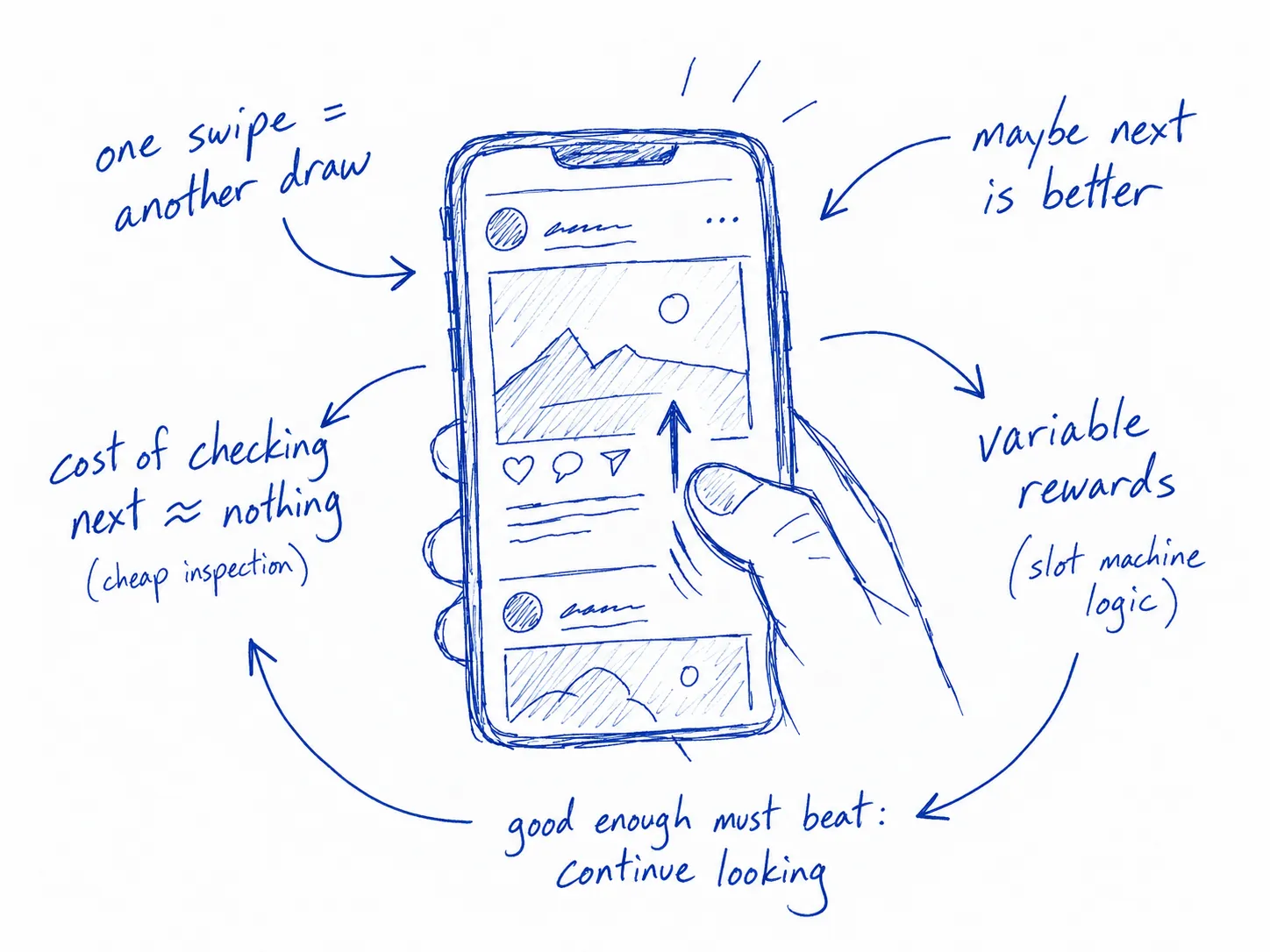
Social media has refined the mechanism. On TikTok or Instagram, the next thing is not another channel you deliberately select so much as something already waiting beneath the current thing. There is an obvious slot-machine quality to it: one swipe buys another draw. Whatever is in front of you may be perfectly fine, but the cost of finding out whether the next thing is funnier, stranger, more beautiful, or more precisely tuned to you is effectively nothing.
Dating apps seem to extend the same structure into a considerably more consequential domain. I say “seem” because, after twenty years of marriage, my expertise here is more anthropological than lived, but the mechanism is hard to miss. A person in front of you doesn’t merely compete with someone on the screen, but with the imagined person behind the next swipe. Someone could be more interesting, more attractive, less difficult, or simply different in a way that becomes important only once the current relationship begins to feel ordinary.
There are well-worn explanations for all of this: too much choice, FOMO, variable rewards, commitment anxiety, addictive design. They probably all explain something, but what interests me more is how cheap it continues to become to inspect another possibility.
Choosing has always meant leaving alternatives unexplored. What technology has progressively reduced is the effort required to scratch the uncertainty around those alternatives. If changing the channel means getting off the couch, a mediocre program gets some space to become interesting; if finding another potential partner requires going somewhere, talking to strangers, and perhaps being rejected, the person already in front of you benefits from a certain amount of friction.
Friction ended searches, but that doesn’t make friction virtuous. It also kept people in bad shows, bad jobs, and bad relationships because alternatives were difficult to find or pursue. But it performed a function without anyone particularly designing it to. Increasingly, we have to decide for ourselves when the search has gone on long enough.
Generative AI makes that stranger because it changes not only the cost of looking, but what “looking” means. Imagine opening a restaurant menu and finding ten dishes, none of which appeals to you. That dissatisfaction tells you something useful: perhaps you are not hungry, perhaps you’re having a bad day, or perhaps you are simply in the wrong restaurant. What the menu cannot do is ask why you disliked the first ten dishes and use the answer to invent an eleventh.
A generative system can. Tell it the options are too safe and it can produce stranger ones; tell it the strange ones are impractical and it can ask what you mean by practical. Inexpensive? Feasible? Socially acceptable? Politically acceptable? At that point you are refining the standard by which the next set of options will be generated.
That feels importantly different from having a very large menu. With television, the programs already exist; with a dating app, the people presumably exist. However enormous the set may be, there is still some meaningful sense in which I am exploring something outside myself. A generative system changes the question from Is there something better out there? to something closer to What else could exist if I asked in the right way? An unsatisfactory answer no longer necessarily tells me to leave. It gives me material for the next request.
Scratching the Itch Creates More Skin
An LLM can not only change the options being considered, but can change the perspective of person doing the considering. This sounds a lot like learning because it is. When I first watched Fellini’s 8½, I experienced much of it as stream of consciousness: beautiful, funny, sometimes baffling. Learning more about what Fellini was doing changed the film without changing a single frame. What had seemed like digression began to feel like a deliberate exploration of memory, identity, and the different ways a person can inhabit his own life. The movie got better because I acquired a better way of seeing it. Reading can do this. At their best, teachers do it. Critics do it. Expertise changes the judge.
The distinction I find myself focusing on is that with 8½, the learning runs one way. However much the movie changes what I am able to see and appreciate in it, my changed appreciation does not feed back into the movie itself. And even if I could explain everything I had come to value and Fellini were somehow available (and willing!) to respond, he would still be making Fellini’s movie. There would still be another intelligence on the other side of the exchange, with purposes and judgments of its own.
A generative system creates a different relationship. My response to what it makes becomes part of what it makes next: I reject one option, qualify another, explain why a third almost works, and those reactions become increasingly rich evidence about what I mean by “better.”
But the causality runs both ways. What the system produces is also teaching me how to judge what it produces next. I notice a distinction because it surfaced one; I acquire a new criterion because an answer exposed something I had not been considering; I become more demanding, and that increased demand becomes part of the specification for the next thing.
My preferences shape the output, the output shapes my preferences, and after enough turns it becomes difficult to say which is adapting to which. To call the result “made for me” makes me sound more like a consumer than a participant; to call it “made by me” gives me considerably more authorship than I deserve. It is closer to saying that I am iteratively eliciting it. The thing takes shape through my reactions to previous versions, while those versions are simultaneously shaping the judgment I bring to the next one. Some of the distinction between appreciation and specification blurs.
That is often exactly what I want. If I am refining an argument, designing a presentation, or trying to find the right structure for an idea, that responsiveness is tremendously satisfying. But it introduces a blind spot into the assumption that successive iterations are simply getting “better.” Satisfaction and improvement are not quite the same thing, particularly when the critic’s own taste is being formed inside the same loop.
If overfitting is the right metaphor, it may not only be happening in the thing produced. It may be happening in me. As the two adapt to one another, the independence between them, and the resistance that comes from encountering something not already involved in my developing criteria, becomes harder to locate. And Fellini matters here for exactly that reason. He could disappoint me on purpose. He could hear what I had learned to value and decide that giving it to me would make the work worse.
The generative loop has no equivalent commitment to its own movie.
That clarifies something that feels unusual, but it creates another problem: local uncertainty falls while global uncertainty rises. I can ask a question and genuinely understand something better five minutes later, while that same answer exposes questions I did not previously know existed. I know more, but I am also, inconveniently, less sure where the edge of the problem is.
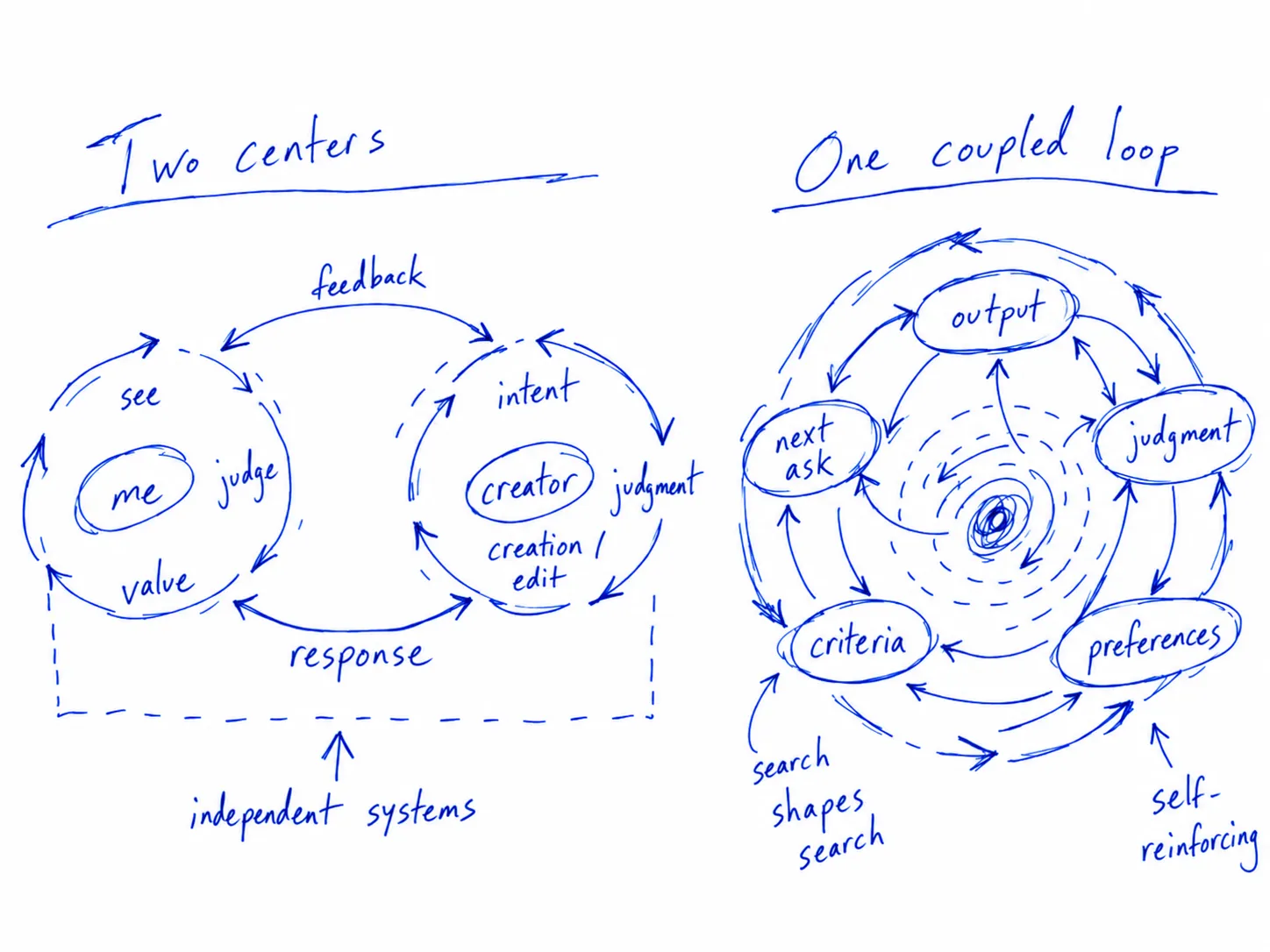
This is still recognizably learning. The difference is that the learning can immediately become a specification. Maybe there is a better answer becomes maybe I don’t yet understand what better means, which can become now that I understand better differently, make me another one. A question about which option to choose can turn into a question about the criteria, and then into a question about what problem I am actually trying to solve. The purpose that might have told me when the inquiry was complete can itself become an object of inquiry.
This can be maddening, but it can also be extremely useful, which is why “just stop overthinking it” feels inadequate. The rabbit hole keeps paying out. Not reliably—most branches are merely interesting—but often enough that the next turn remains tempting, and occasionally enough that it genuinely changes how I understand the problem. The slot machine has returned at the level of ideas.
Jorge Luis Borges seems difficult to avoid here. His Library of Babel imagines a possibility space so vast that the meaningful thing may exist somewhere inside it and still be practically impossible to find, but the image that keeps occurring to me is slightly different: a library that grows a door to a new room while I search it, with the reader and the library rearranging one another as they go.
That raises a more uncomfortable question: who, exactly, is constructing whom? In The Circular Ruins, Borges imagines a man who spends years dreaming another man into existence, only to discover that he too is someone else’s dream. The structure is useful here. If the system participates in generating the options, refining the criteria, and reframing the question, while I am simultaneously shaping what it produces through my responses to it, I am no longer simply standing outside a possibility space evaluating its contents. I am participating in the construction of the space that is helping develop my judgment. And that is where the argument develops a problem of its own.
The Problem with This Argument
At some point while thinking through all of this, I noticed that the system was doing something else. It was helping the idea feel more important. The obvious version of the problem is sycophancy. Language models are agreeable. Feed one a half-developed thought and it is rarely inclined to respond, “No, that is boring and probably not worth pursuing.” But obvious praise is relatively easy to notice.
The more beguiling form is sustained attention. The machine can challenge me, expose weak points, distinguish an idea from adjacent ideas, find analogies, generate objections, and help repair the argument. It does not have to tell me the idea is important. Sustained attention can imply that on its own. There is a kind of flattery in treating every thought as worthy of another good question, particularly because the questions are often genuinely good. And because I help build the resulting argument by rejecting weak formulations, pushing back when an analogy does not fit, or asking whether a distinction actually matters, it feels discovered rather than supplied.
That matters because the interaction is putting my intuition through something that resembles intellectual work, and surely that should count for something. An argument that survives objections should inspire more confidence than one that has never encountered them; a distinction that survives repeated attempts to collapse it is probably more useful than the vague intuition from which it began.
So the answer cannot simply be that coherence proves nothing. How much confidence should coherence buy when the same coupled system is generating the objection, the repair, and the growing sense that the exercise deserves another turn? And what about when my own standards for what counts as a good objection or successful repair are developing inside that same exchange?
This is roughly where Immanuel Kant becomes useful. Reason does not merely accept the thing in front of it; it looks for the conditions that explain the thing, and then for the conditions behind those. That tendency is indispensable because it is how we move from observation toward understanding, but Kant’s warning is that the same tendency can outrun what experience actually warrants.
The obvious Socratic objection is almost irresistible: if reason can mislead us, how exactly do we discover that? Through reason, obviously. There is no balcony outside our own cognition from which we can inspect it without using the same instrument we are attempting to examine. Kant’s point is not that reason should distrust itself; it is that reason has to become capable of examining the limits of its own jurisdiction. That lands uncomfortably close to the problem here. The increasingly coherent structure produced through a human-machine conversation may be revealing something, or it may be becoming increasingly good at supporting itself. Those possibilities are not mutually exclusive.
And a thought about channel surfing has now accumulated Fellini, Borges, Kant, and Socrates, which is exactly the kind of development that makes me suspicious of any argument, especially my own. There is a point at which an idea acquires enough intellectual furniture that one should at least check whether there is a house to hold it.
Eventually something outside the conversation has to resist us: evidence, other people, consequences, perhaps someone who has spent thirty years studying decision theory explaining that I have elegantly rediscovered something settled in 1975.
So where does that leave “enough”? I began with a practical intuition: when another option becomes cheap to inspect, the current option has to compete with continuing to look. Generative AI extends that problem because the next option does not need to exist before I go scouting for it, and because the process of looking can change both what gets generated next and the standards by which I will judge it.
At every stage, continuing can be justified. The next turn may actually make the idea better, or make me better at seeing it, or make the two more tightly fitted to one another in a way I experience as improvement. Distinguishing among those possibilities is itself another question.
Most inquiry ends for ordinary reasons. The deadline arrives. The meeting begins. Dinner is ready. Someone becomes tired. The thing gets published. You just lose interest. Those are not proofs that an argument is complete. They are encounters with limits.
There is almost certainly another distinction I could make here, another objection worth considering, probably another Borges story that would improve the metaphor, and none of those possibilities is obviously worthless. That is exactly what makes stopping so difficult.